
01
Supplier and distribution interfaces
Connectivity to the suppliers, aggregators and distribution interfaces your commercial model depends on — assessed across the whole journey, not just the search response.
SearchBookService
Integration engineering
Connecting travel systems is mostly an exercise in discovering what a platform will not do. We scope integrations against the interfaces that genuinely exist and the access your vendors actually permit, and we tell you the limits before the contract, not after.

The business problem
The demo works. The search comes back. Then the booking path, the servicing path, the payment reconciliation and the edge cases arrive, and the integration that looked complete turns out to cover the first ten per cent of the journey.
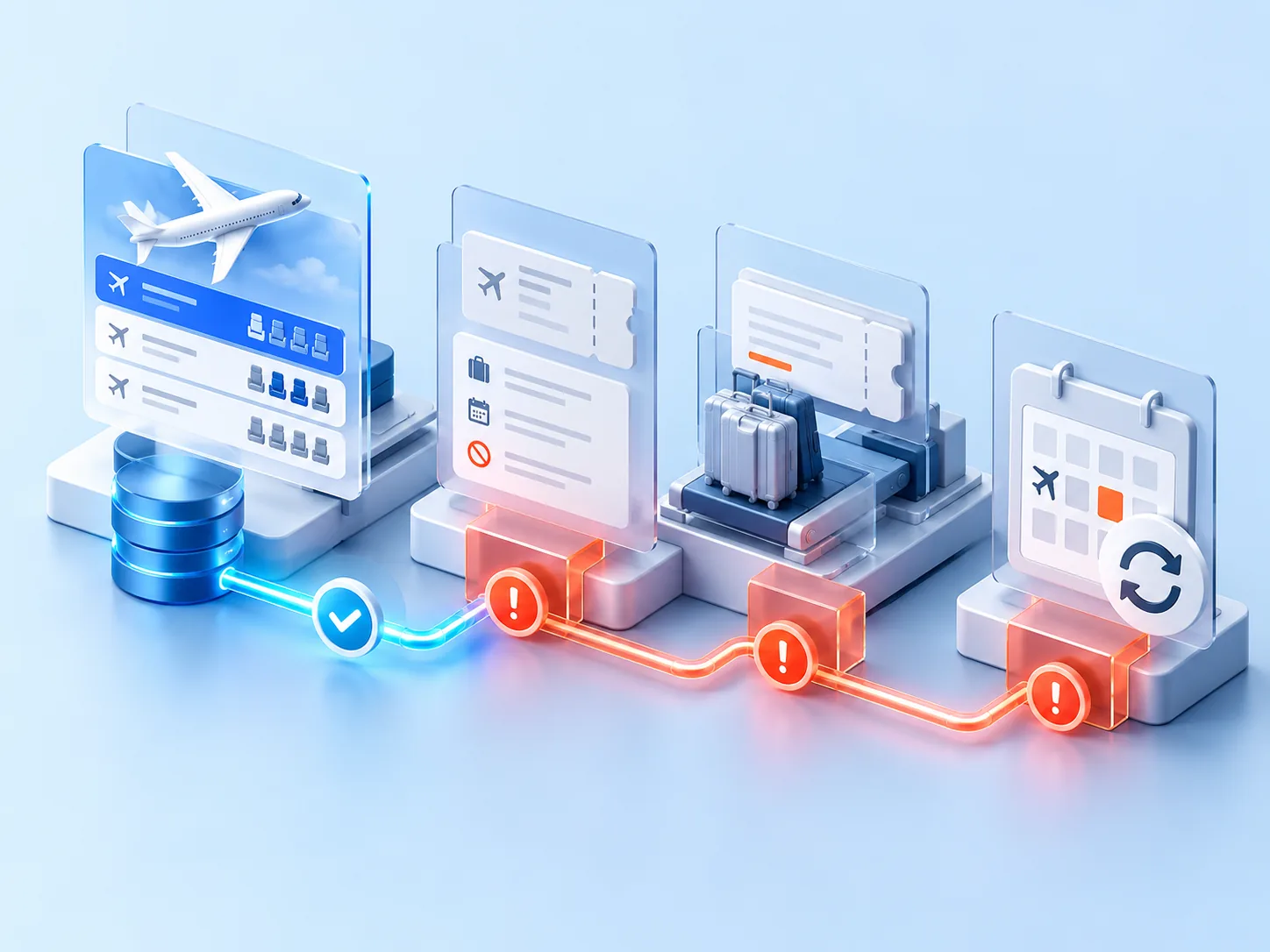
Search works but booking, amendment and cancellation are a different certification entirely.
The sandbox behaves nothing like production traffic, volumes or failure modes.
Rate limits and throttling appear only once real load arrives.
Two suppliers describe the same concept differently, and nobody owns the translation.
Error handling is an afterthought, so a broken flow is reported by a customer rather than a monitor.
Access depends on a commercial agreement nobody on the project team can actually influence.
Our approach
Every integration engagement starts with an assessment of what is genuinely available: which operations the interface supports, what the access terms permit, what the realistic throughput is, and which parts of the journey the integration will not cover.
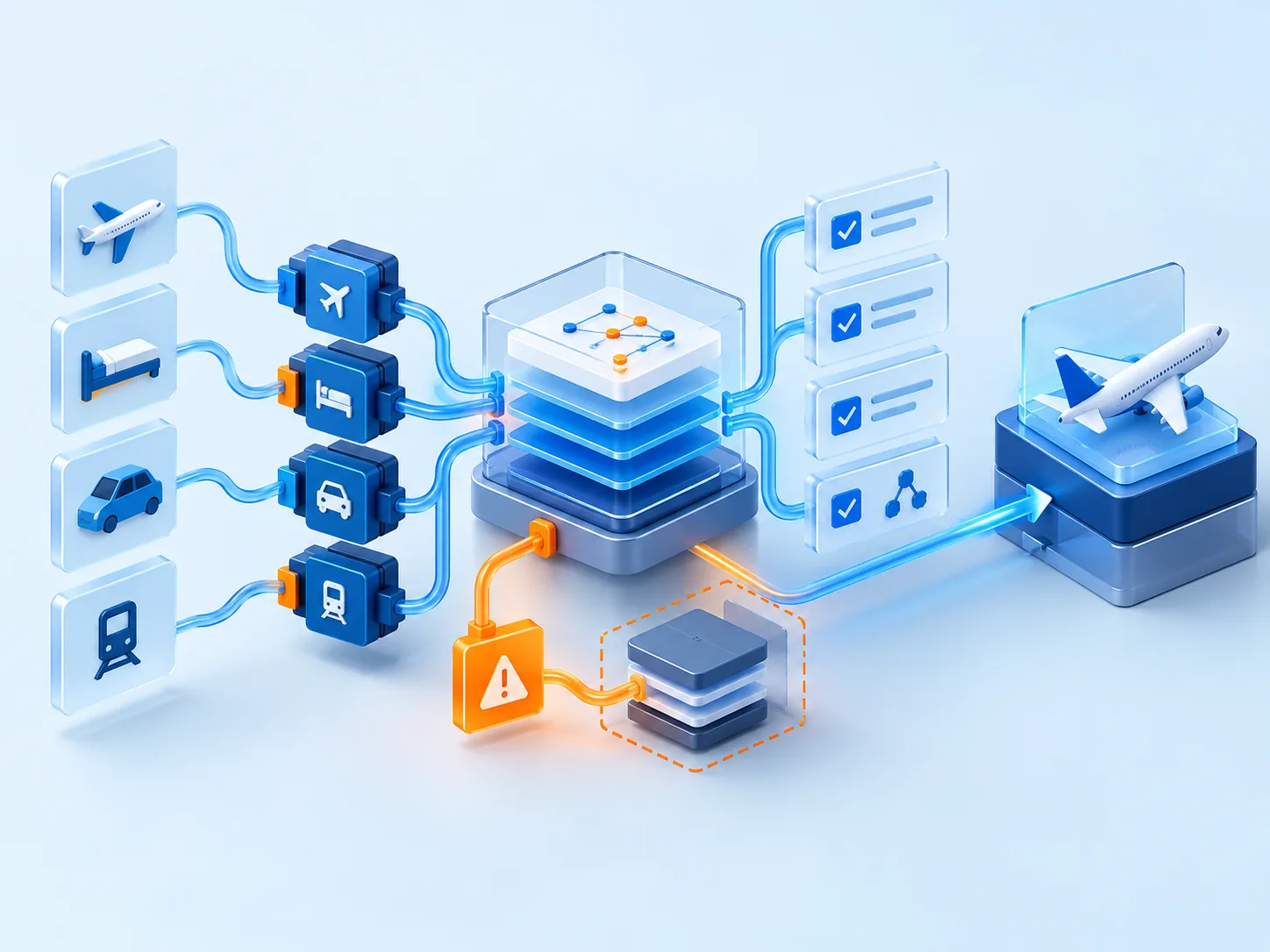
We treat integration as engineering rather than plumbing. That means explicit contracts between systems, deliberate failure behaviour, idempotency where actions can be retried, and enough observability that a broken flow announces itself instead of waiting to be discovered.
We do not imply affiliation, partnership or certification with any platform we integrate against. Supplier connectivity is assessed per project, and where the answer is that a particular integration cannot support what you need, that is a finding we deliver early rather than a problem we discover on your budget.

Capabilities
Scope depends entirely on what your platforms expose and what your agreements permit. These are the categories we work across.
01
Connectivity to the suppliers, aggregators and distribution interfaces your commercial model depends on — assessed across the whole journey, not just the search response.
02
Customer and opportunity data kept coherent between the booking path and the commercial systems, without the duplicate records that corrupt reporting.
03
The systems behind the front desk connected to the ones in front of it, so information is entered once and staff stop reconciling by hand.
04
The finance-facing half of the journey, which is where integration shortcuts eventually surface as an accounting problem rather than a technical one.
Delivery model
Scope and sequence are agreed before engineering begins, and every stage is reviewable.
01
Interface capability, access terms, environments, rate limits and the operations genuinely supported end to end. This is a short, deliberately sceptical phase.
02
Define one internal representation and translate suppliers into it, so a second supplier is an addition rather than a rewrite.
03
Take one supplier all the way through search, book, service and cancel before adding breadth. Depth first exposes the problems that breadth hides.
04
Timeouts, partial failures, duplicate submissions, stale inventory. The happy path is the part that was never going to be the problem.
05
Monitoring, alerting and documentation on the flows that carry revenue, written for the team who will operate them.
How we work together
Start with a conversation. Commit to scoped work only when a deeper review or a build is genuinely the right next step — and only once the scope is written down.
Start here — free call
01
Free30 minutes
One workflow, discussed with a solutions architect. What it costs you today, what is technically in the way, and whether anything further is warranted.
02
USD 5,0004 weeks
A scoped review when the picture is genuinely unclear — several systems, an unproven integration, or a decision nobody can size yet.
03
From USD 25,000Scoped per engagement
An agreed priority turned into working software, connected systems or a governed AI workflow, delivered in stages you can release and review.
Larger platform programmes start at USD 75,000. All figures are in USD and are starting points rather than quotes — scope, integration surface and the number of systems involved move the number. Commercial terms are always confirmed in writing before work begins.
Before we talk
We do not claim certification, partnership or affiliation with any platform, and you should treat claims like that carefully when you hear them elsewhere. What we bring is engineering experience with these interfaces. The commercial access is yours, and what it permits is something we establish jointly at the start of the engagement.
It depends almost entirely on what the interface supports and how quickly access and certification move — both of which are usually outside the engineering team's control. We scope the engineering honestly and flag the dependencies that are not ours, so the timeline you get reflects the whole path rather than just our part of it.
Sometimes, and rarely well. There are options — file exchange, database-level integration, screen automation — and each carries operational fragility that has to be understood before it is chosen. We will explain the trade-offs rather than presenting the workaround as equivalent to a supported interface.
It is a question of when, not if, which is why the canonical model matters. A change that would otherwise ripple through your platform is contained in the translation layer. Ongoing engineering support for exactly this is something we scope explicitly rather than assume.
Keep exploring
Start with a conversation
Bring us the process that is slowing you down, the system that will not connect, or the platform that needs to evolve. We will tell you what we would do about it — and whether you need us at all.
Free · 30 minutes with a solutions architect · No obligation to commission an audit · sales@appnox.ai