
01
Enquiry intake workspace
A single place where every inbound request lands, with clear ownership, an ageing view and the traffic your team actually receives rather than the traffic a demo assumes.
QueueOwnershipSLA visibility
Travel technology · Workflow automation
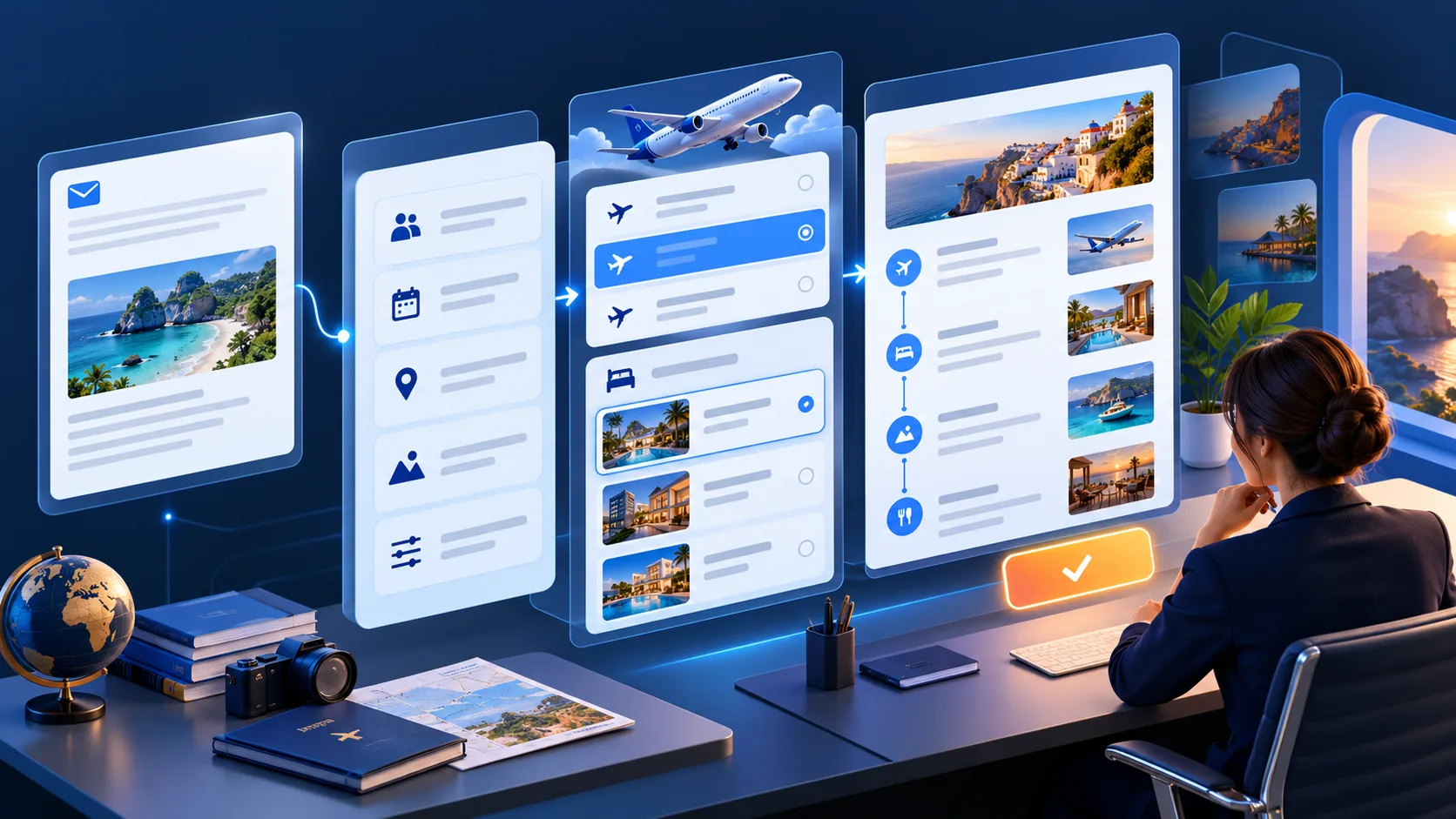
The gap between a traveller's request arriving and a consultant being able to quote it is where most travel operations lose their margin. We close that gap with structured capture, assisted preparation and a human who still makes the call.
The business problem
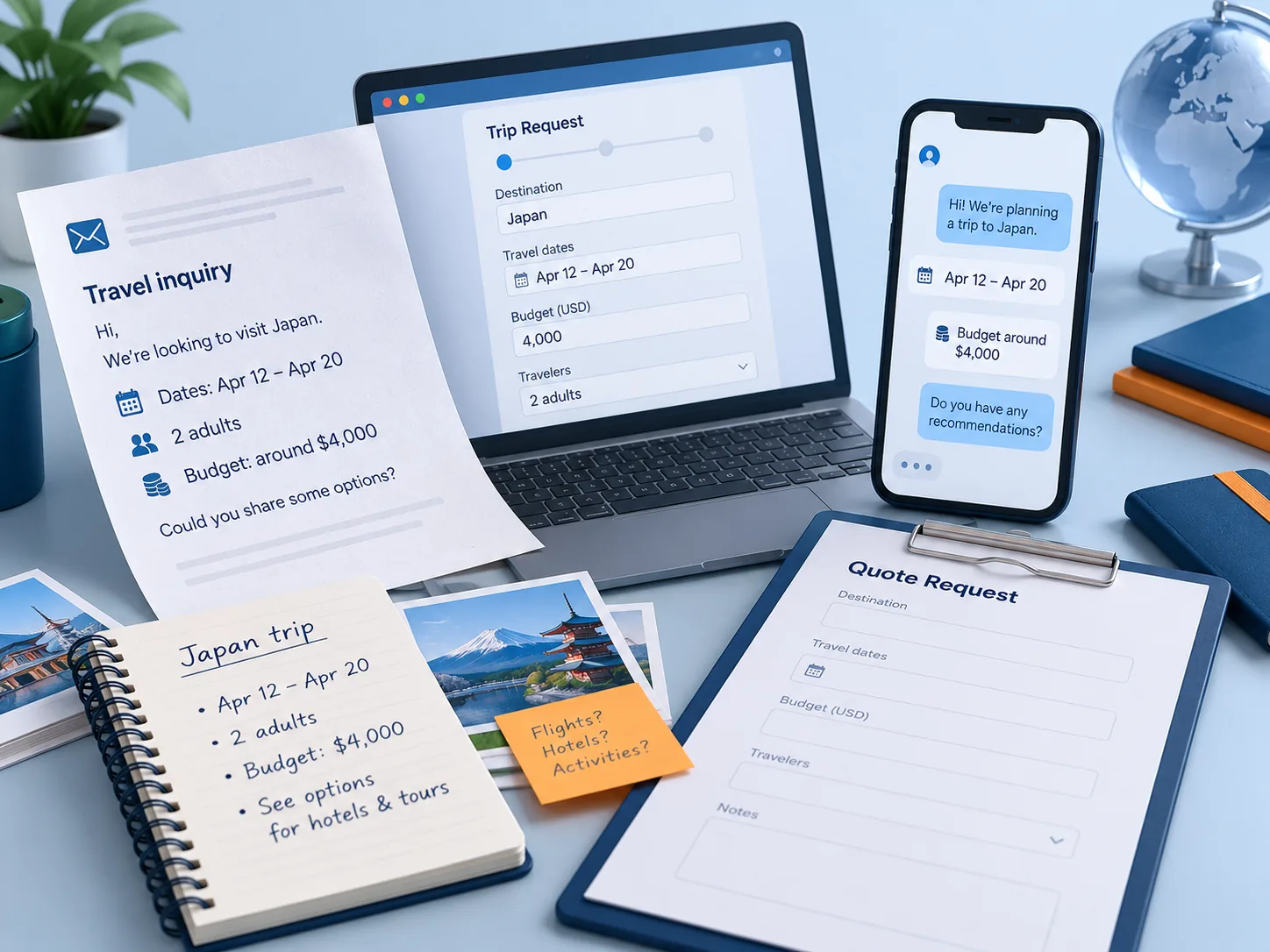
A request arrives as prose — in an email, a web form, a WhatsApp message, a partner portal. Before anyone can price it, somebody has to read it, interpret it, chase what is missing and re-key it into the system that actually produces a quote.
The same traveller details are typed into three systems because none of them talk to each other.
Requests sit unqualified overnight because the consultant who owns them is mid-itinerary on something else.
Two consultants quote the same request differently, because "complete" was never defined anywhere.
Missing information is discovered at quoting time rather than at capture, so the clock restarts.
Context lives in an inbox, so whoever picks the request up second starts from nothing.
Nobody can say how long qualification actually takes, because it was never a measured step.
Our approach
The useful automation here is rarely a fully autonomous trip planner. It is a better handoff between the request arriving and the consultant who has to turn it into a priced itinerary.
We start by defining what a complete enquiry actually contains for your business — party composition, dates and flexibility, origin, budget band, service class, special requirements, source and ownership. That definition is the contract everything else is built against, and writing it down usually surfaces more disagreement inside a travel business than the technology ever does.
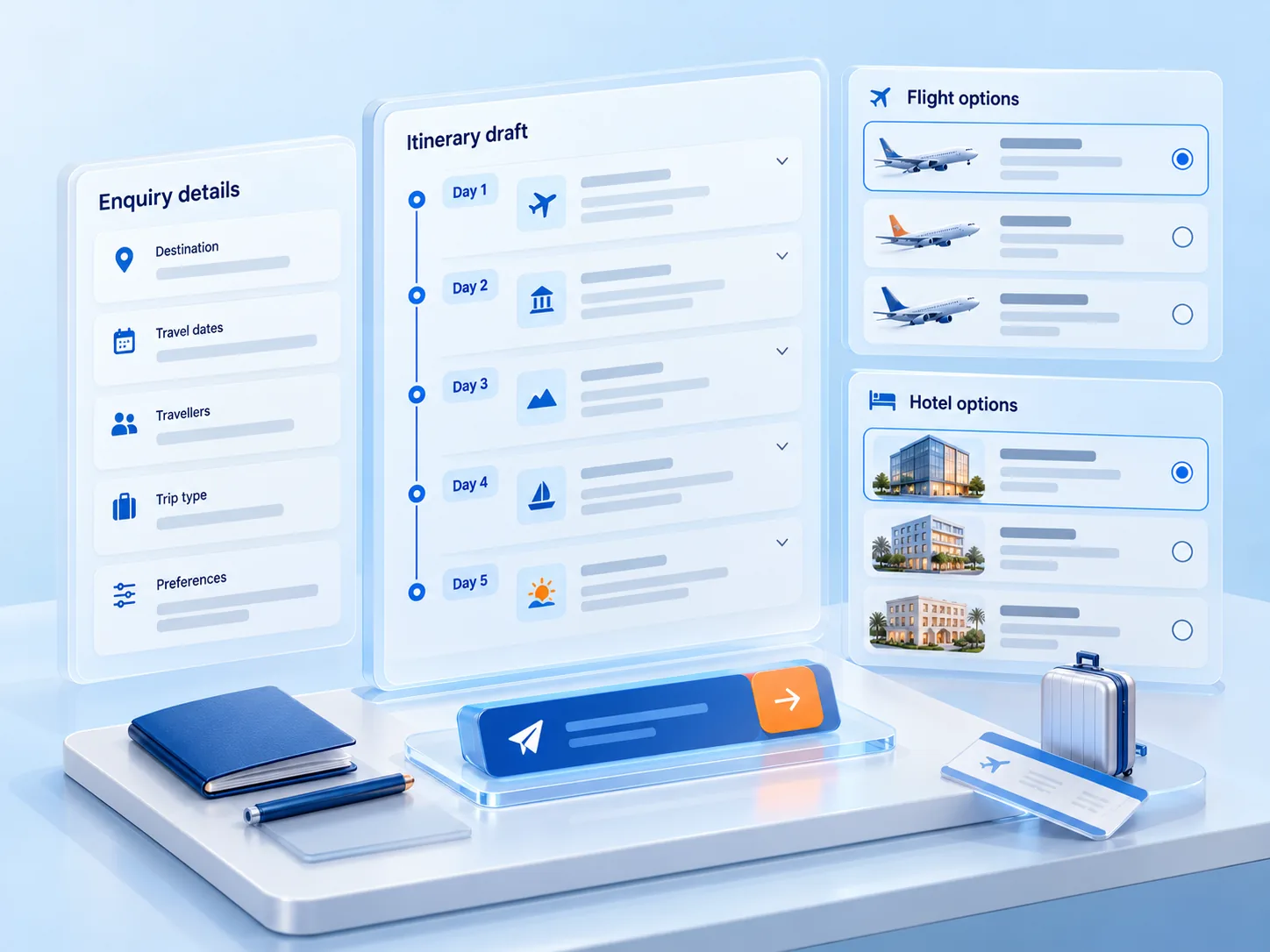
From there we build capture that accepts the messy real-world input you actually receive, structuring that maps it onto your definition, and an assist layer that prepares the consultant's next step. What the system may do on its own and what needs a person to approve it is decided during design, not bolted on afterwards.

Capabilities
Most engagements start with one channel and one itinerary type, then widen once the definition has survived contact with real traffic.
01
A single place where every inbound request lands, with clear ownership, an ageing view and the traffic your team actually receives rather than the traffic a demo assumes.
02
Prose turned into fields your systems can use, with missing or ambiguous information surfaced at capture time instead of discovered three days later at quoting.
03
A prepared starting point — structure, sequencing, the questions worth asking back — that a consultant edits rather than builds from a blank page.
04
Clean records created in the systems you already run, without the duplicate contacts that make pipeline reporting meaningless six months later.
Delivery model
Scope and sequence are agreed before engineering begins, and every stage is reviewable.
01
Agree what a qualified enquiry contains for your business, by itinerary type. This is a commercial conversation more than a technical one, and it is the step most often skipped.
02
Measure what qualification costs today — elapsed time, touches, rework rate. Without this there is nothing to compare the result against, and every later claim is an assertion.
03
Take the highest-volume channel all the way through to a consultant-ready record, rather than building a shallow layer across every channel at once.
04
Run it alongside the existing process with genuine enquiries. Real inbound is messier than any sample, and this is where the definition gets corrected.
05
Add channels and itinerary types once the first is behaving, measuring against the baseline each time rather than assuming the gain repeats.
How we work together
Start with a conversation. Commit to scoped work only when a deeper review or a build is genuinely the right next step — and only once the scope is written down.
Start here — free call
01
Free30 minutes
One workflow, discussed with a solutions architect. What it costs you today, what is technically in the way, and whether anything further is warranted.
02
USD 5,0004 weeks
A scoped review when the picture is genuinely unclear — several systems, an unproven integration, or a decision nobody can size yet.
03
From USD 25,000Scoped per engagement
An agreed priority turned into working software, connected systems or a governed AI workflow, delivered in stages you can release and review.
Larger platform programmes start at USD 75,000. All figures are in USD and are starting points rather than quotes — scope, integration surface and the number of systems involved move the number. Commercial terms are always confirmed in writing before work begins.
Before we talk
No, and an implementation sold on that basis would be a bad one. The work this removes is clerical — reading, re-keying, chasing missing details, rebuilding context somebody already had. Judgement about a traveller, a supplier relationship or a commercial exception stays with your consultants, which is where the value of a travel business actually sits.
It is designed to be wrong safely. Ambiguous or low-confidence extractions are flagged rather than committed, and anything commercially sensitive routes to a person by default. The consultant sees what was inferred and can correct it, and those corrections are the signal used to improve the extraction over time.
That is the usual case. What we can read and write depends on the interfaces your CRM exposes and the access your vendor permits, which we establish early rather than assume. Where a supported interface does not exist, we say so before the scope is agreed rather than after.
One channel and one itinerary type is typically a matter of weeks rather than quarters, because the scope is deliberately narrow. What takes longer is the definition work at the start and the widening at the end — both of which are paced by your team's availability more than by engineering.
Keep exploring
Start with a conversation
Bring us the process that is slowing you down, the system that will not connect, or the platform that needs to evolve. We will tell you what we would do about it — and whether you need us at all.
Free · 30 minutes with a solutions architect · No obligation to commission an audit · sales@appnox.ai