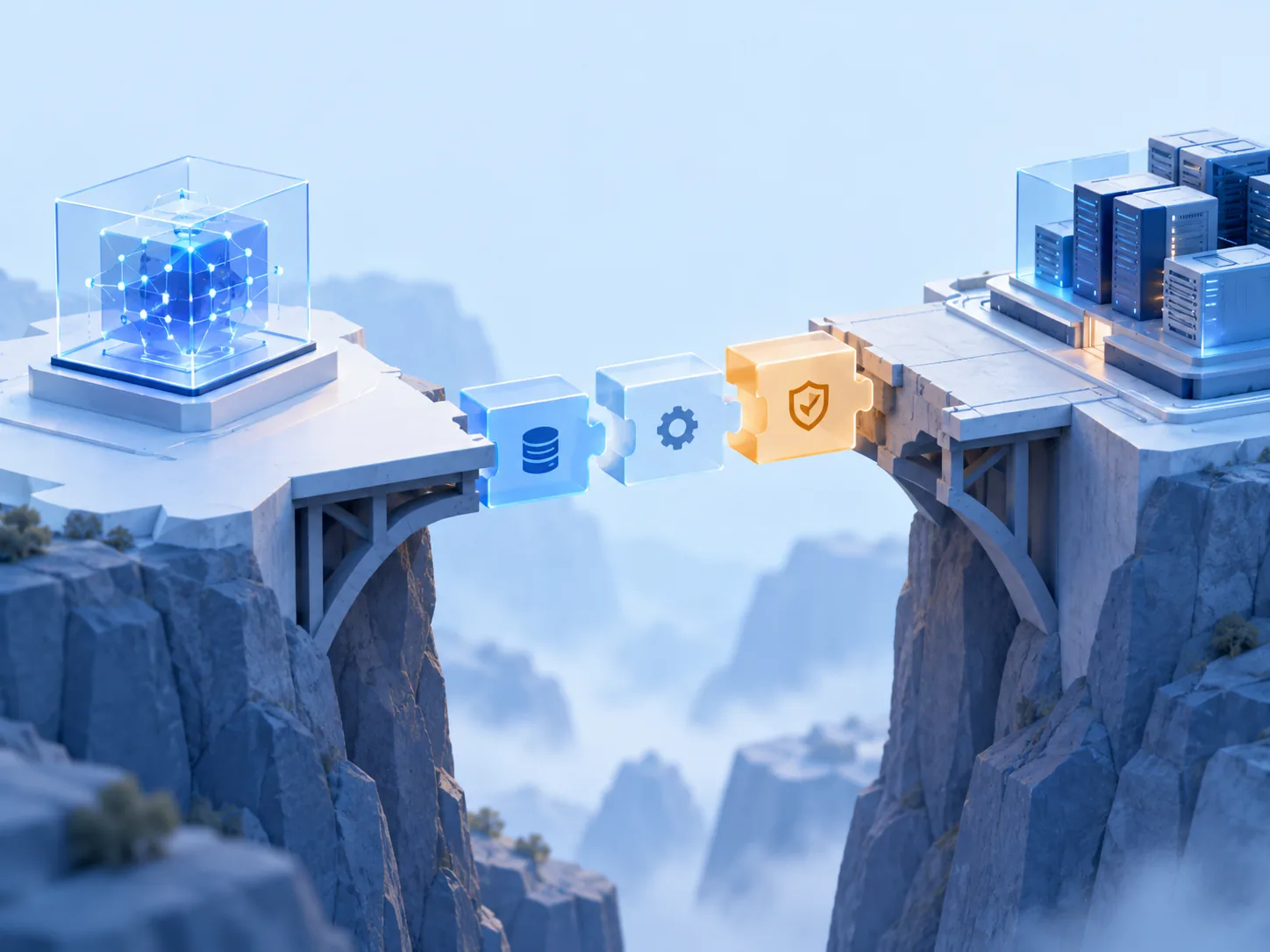
Most AI projects do not fail at the model. They fail at the operation.
Appnox takes AI from a proof of concept somebody built last quarter to something operating inside a governed workflow — with defined approval points, real system integration, and a measurable operational outcome attached to it.
The gap between a working demo and a working operation.
The pilot produced good output. Eighteen months later it is still a pilot, and the reasons are almost never about model quality.
Nobody defined what the system is allowed to do without a human approving it.
It was never connected to the systems of record, so its output had to be re-entered by hand.
There is no defined behaviour for an uncertain result, so it guesses.
No baseline was captured, so the benefit cannot be proven to anyone holding a budget.
Nothing monitors it, so quality drift would go unnoticed until a customer complained.
The people whose work it changes were not involved in designing it, and quietly route around it.
Our approach
Design the boundary, then build inside it.
The important question about an AI step is not whether it can perform an action. It is whether the business has decided when that action is permitted, and what happens when the result is uncertain.
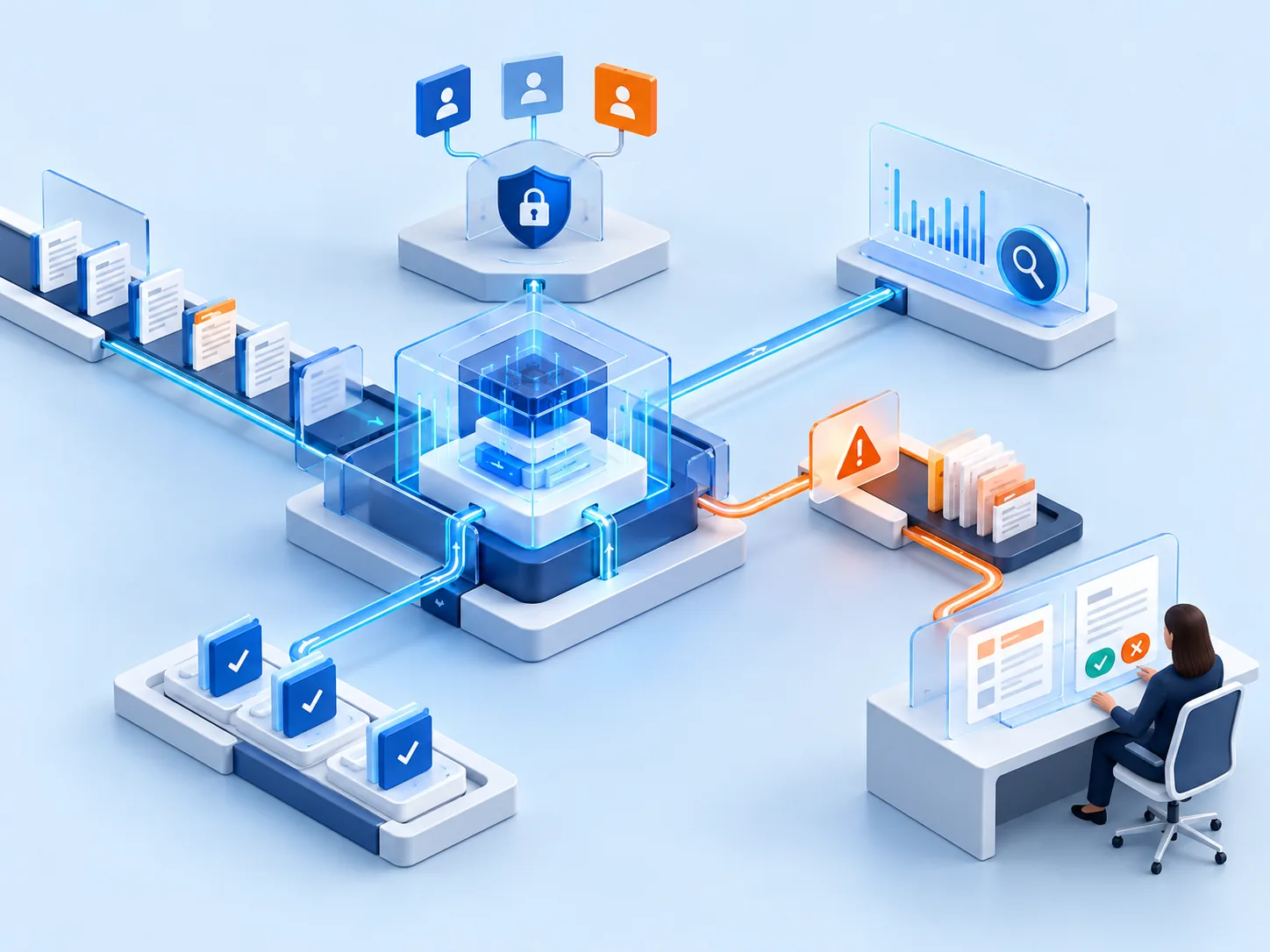
So the first deliverable is a boundary, not a model. Which actions may complete automatically because they are reversible and low-value. Which require a person to approve them. Which must never run unattended because the commercial or duty-of-care exposure is real — and those sit on the human side by default rather than by exception.
Then the engineering: integration with the systems that actually hold the records, context assembly so a person reviewing a recommendation can judge it in seconds, evaluation against real cases rather than curated ones, and logging that lets you answer "why did this happen" months later. The model is a component. The operation is the deliverable.
Action boundary designAn explicit register of what may run unattended, what needs approval and what never runs alone.
Systems of record integrationOutput that lands in the systems your business already runs, not in a separate tool nobody opens.
Human review that worksContext assembled so approving or rejecting takes seconds rather than a re-investigation.
Evaluation against real casesMeasured on your traffic and your edge cases, not on a curated sample.
Monitoring and auditQuality drift surfaced early, and a record of what was proposed, approved, and on what basis.
Where AI earns its place
Four patterns that reliably work.
These have a common shape: high volume, well-understood rules, a measurable outcome and a recoverable mistake.
01
Structuring unstructured input
Turning prose — emails, forms, documents, messages — into fields your systems can use, with ambiguity flagged rather than guessed. Usually the highest-return and lowest-risk starting point.
ExtractionValidationGap flagging
02
Preparing work for approval
Assembling context and proposing a next action for a person to accept, edit or reject. Most of the time saving, a fraction of the risk of unattended execution.
DraftingContextOne-step review
03
Retrieval over your own knowledge
Answers grounded in your policies, contracts and documentation with the source shown — and respecting the permissions of whoever is asking.
GroundingCitationsPermissions
04
Triage and routing
Deciding what matters most right now and getting it to the right person with the context attached. Low risk, and it compounds across every queue in the business.
PrioritisationClassificationEscalation
Delivery model
From one workflow to an operation that depends on it.
Each stage produces something you could stop after. That is deliberate: an AI programme that only pays out at the end is one you cannot safely pause.
01
Pick the workflow
Find one that is high-volume, well-understood, measurable and reversible — and capture the baseline before anything changes. Without the baseline, every later claim is an assertion.
02
Write the boundary
Agree action by action what may run unattended, what needs approval and what is off-limits, signed off by whoever owns the commercial risk.
03
Build the assisted version
Context assembly and reviewed recommendations first. This captures most of the value and carries a fraction of the exposure.
04
Evaluate on real traffic
Measure against the baseline using your own cases, including the awkward ones. Correct the boundary where reality disagrees with the design.
05
Automate deliberately, then widen
Move genuinely safe actions to unattended execution once the assisted version has earned it, then extend to the next workflow with evidence rather than optimism.
Governance
What we put in place, regardless of scope.
Defined approval pointsDocumented, enforced in the system, and owned by a named person in your business.
Uncertainty handlingLow-confidence results route to a person with context, rather than resolving to a best guess.
Action loggingA durable record of what was proposed, approved and executed, and on what information.
Evaluation harnessA repeatable way to measure quality on your own cases as the system and the models change.
Access and permissionsRetrieval and actions respect the permissions of the person the system is acting for.
Replaceable model layerArchitecture that lets you change provider without rebuilding the workflow around it.
How we work together
A free first step. A scoped investment after that.
AI implementation engagements start with a conversation about one workflow. Where several systems are involved and nobody can size the work yet, the audit exists for exactly that situation.
Start here — free call
01
Strategy call
Free30 minutes
One workflow, discussed with a solutions architect. What it costs you today, what is technically in the way, and whether anything further is warranted.
Larger platform programmes start at USD 75,000. All figures are in USD and are
starting points rather than quotes — scope, integration surface and the number of systems involved
move the number. Commercial terms are always confirmed in writing before work begins.
Before we talk
A few useful answers.
Usually because a pilot proves a model can produce a plausible output, which is a different question from whether an operation can depend on it. Production needs defined approval points, integration with the systems of record, handling for uncertain results, monitoring, and someone accountable for the outcome. Those are engineering and governance problems, not model problems, and they are where most pilots stop.
By looking for a workflow that is high-volume, well-understood, measurable and reversible. High-volume so the gain is material; well-understood so the rules can actually be written down; measurable so the result can be proven; reversible so a mistake is recoverable. A workflow missing any of these is a poor first candidate however attractive it looks.
That is a common finding and it is better discovered in week two than month six. Part of early assessment is establishing whether the data can support the use case at all. If it cannot, the honest sequence is data foundation first — which is less exciting than an AI project and considerably more likely to produce one that works.
Your business is, which is exactly why the boundary work matters. We design so that anything carrying real commercial or duty-of-care exposure requires a human approval, uncertain results route to a person rather than resolving to a guess, and every automated action is logged with the information it acted on. Accountability cannot be delegated to a model, and a design that implies otherwise is a liability.
We design so the choice is replaceable. Model capability and pricing in this space move quarterly, and architecture that hard-wires one provider ages badly. We will recommend based on the requirement, your data residency and procurement constraints, and we will not imply a partnership or certification we do not hold.
Tell us what your team does repeatedly, what it costs, and which part of it nobody enjoys. We will tell you whether AI is the right answer — and we are comfortable saying it is not.