
01
Platform assessment
A grounded view of what makes change expensive in your specific codebase and process — usually a shorter list than expected, and rarely the list people assume.
ArchitectureDeliveryRisk
Industry · OTAs and platforms
For an OTA or a travel technology company, engineering velocity is commercial velocity. The constraint is rarely ideas — it is how quickly and how safely the platform can absorb a change.

The business problem
Platform businesses know what they want to build. What limits them is a codebase that has accumulated a decade of commercial exceptions and a release process that makes every change feel expensive.
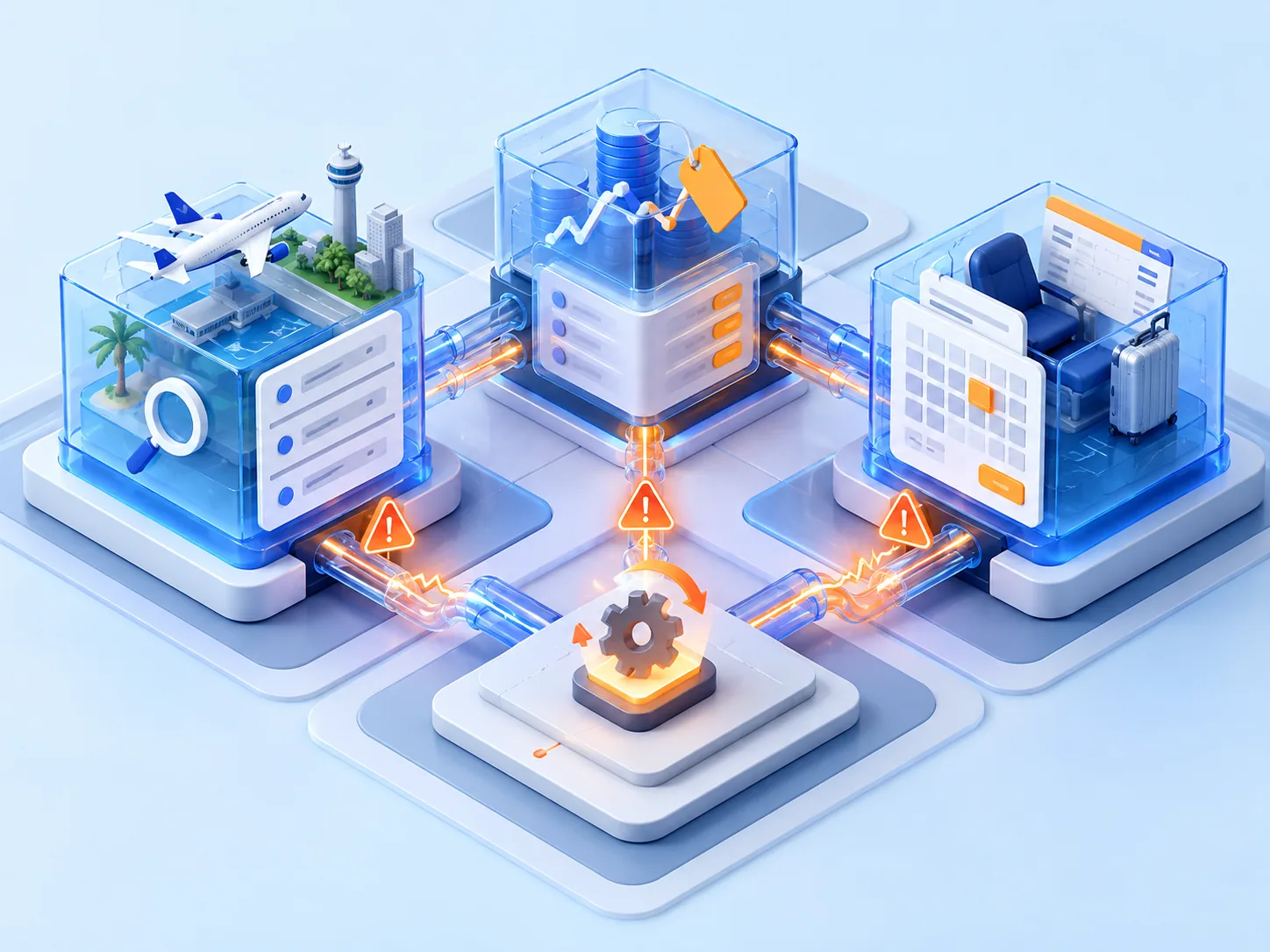
A change that should take days takes weeks because its effects cannot be predicted.
Supplier-specific behaviour has leaked throughout the codebase rather than staying contained.
Releases are infrequent and tense, so improvements are batched and risk compounds.
Conversion friction is known but unfixed because the fix touches too much.
Partner and B2B requirements are handled by special cases rather than by the model.
Adding a supplier is a project rather than a configuration.
Our approach
Most platform businesses we meet do not need a rewrite. They need the specific structural problems that make change expensive to be fixed — usually a canonical model that supplier differences are translated into, and a delivery pipeline that makes releasing routine rather than eventful.
We work inside your existing platform and your existing team where possible. An external team that builds in parallel and hands over something unfamiliar tends to create a second system to maintain rather than a faster one.
The measure of success is not a delivered feature list. It is whether, six months later, your own team is shipping more often with less anxiety than before we arrived.

Capabilities
Determined by whether the immediate constraint is velocity, conversion or supplier breadth.

01
A grounded view of what makes change expensive in your specific codebase and process — usually a shorter list than expected, and rarely the list people assume.
02
One internal representation with supplier adapters at the edge, so onboarding the next supplier is configuration and integration rather than a platform change.
03
Work on the path that carries revenue: performance, error handling, and the friction points that are known but unfixed because they touch too much.
04
The platform your partners and agents work in, where tenancy, permissions and reporting are the difficult part rather than the interface.
Delivery model
Scope and sequence are agreed before engineering begins, and every stage is reviewable.
01
Look at the codebase, the tests, the pipeline and the release history together. The constraint is usually structural and specific rather than general.
02
If releasing is tense, everything else is slower and riskier than it needs to be. This is unglamorous and it compounds.
03
Establish the canonical model and move supplier-specific behaviour to the boundary, one supplier at a time.
04
With change cheaper, work through the known-but-unfixed list in priority order rather than in risk order.
05
Transfer the patterns and the tooling deliberately. If velocity drops when we leave, the engagement did not work.
How we work together
Start with a conversation. Commit to scoped work only when a deeper review or a build is genuinely the right next step — and only once the scope is written down.
Start here — free call
01
Free30 minutes
One workflow, discussed with a solutions architect. What it costs you today, what is technically in the way, and whether anything further is warranted.
02
USD 5,0004 weeks
A scoped review when the picture is genuinely unclear — several systems, an unproven integration, or a decision nobody can size yet.
03
From USD 25,000Scoped per engagement
An agreed priority turned into working software, connected systems or a governed AI workflow, delivered in stages you can release and review.
Larger platform programmes start at USD 75,000. All figures are in USD and are starting points rather than quotes — scope, integration surface and the number of systems involved move the number. Commercial terms are always confirmed in writing before work begins.
Before we talk
Usually alongside them, on a defined slice, with explicit agreement about who owns architecture decisions and release authority. Ambiguity there causes more friction than any technical disagreement. If your team is capable and the constraint is capacity rather than capability, we will say so — that changes the shape of the engagement.
Generally yes, and we would prefer to. Introducing an unfamiliar technology into a platform your team maintains creates a long-term cost that usually outweighs any short-term benefit. The exception is where the current stack is itself the constraint, which is a conclusion that needs evidence.
Incrementally, behind feature flags, with the revenue-bearing paths covered by tests before they are touched, and with monitoring that surfaces a problem before a customer does. If the platform cannot currently support that way of working, establishing it is the first piece of work.
Occasionally, for a small and well-understood system with a clear specification. For a platform carrying a decade of commercial exceptions it almost never is, because the exceptions are the business and reproducing them from memory is how these projects fail in production.
Keep exploring
Start with a conversation
Bring us the process that is slowing you down, the system that will not connect, or the platform that needs to evolve. We will tell you what we would do about it — and whether you need us at all.
Free · 30 minutes with a solutions architect · No obligation to commission an audit · sales@appnox.ai