
Case study · Travel technology
Less repetitive work, more room for travel expertise.
Appnox built an AI-assisted booking workflow for TravelMatic that structures incoming enquiries, supports itinerary preparation and carries customer context into CRM and agent workflows — with complex cases still routed to a human.
The client problem
Consultants were spending the first hour of every enquiry on clerical work.
Enquiries arrived in free-form text and had to be read, interpreted and re-keyed before a consultant could begin quoting. The work was slow, inconsistent between agents, and the customer context routinely failed to travel with the record into CRM.

Requests arrived as prose and were manually interpreted before quoting could begin.
The same details were re-entered across more than one system.
Qualification quality varied between consultants with no shared definition of complete.
Customer context stayed in the mailbox rather than reaching the CRM record.
Missing information surfaced at quoting time rather than at capture.
Complex cases competed for attention with routine ones.
What we built
Structure the enquiry, assist the preparation, keep the judgement.
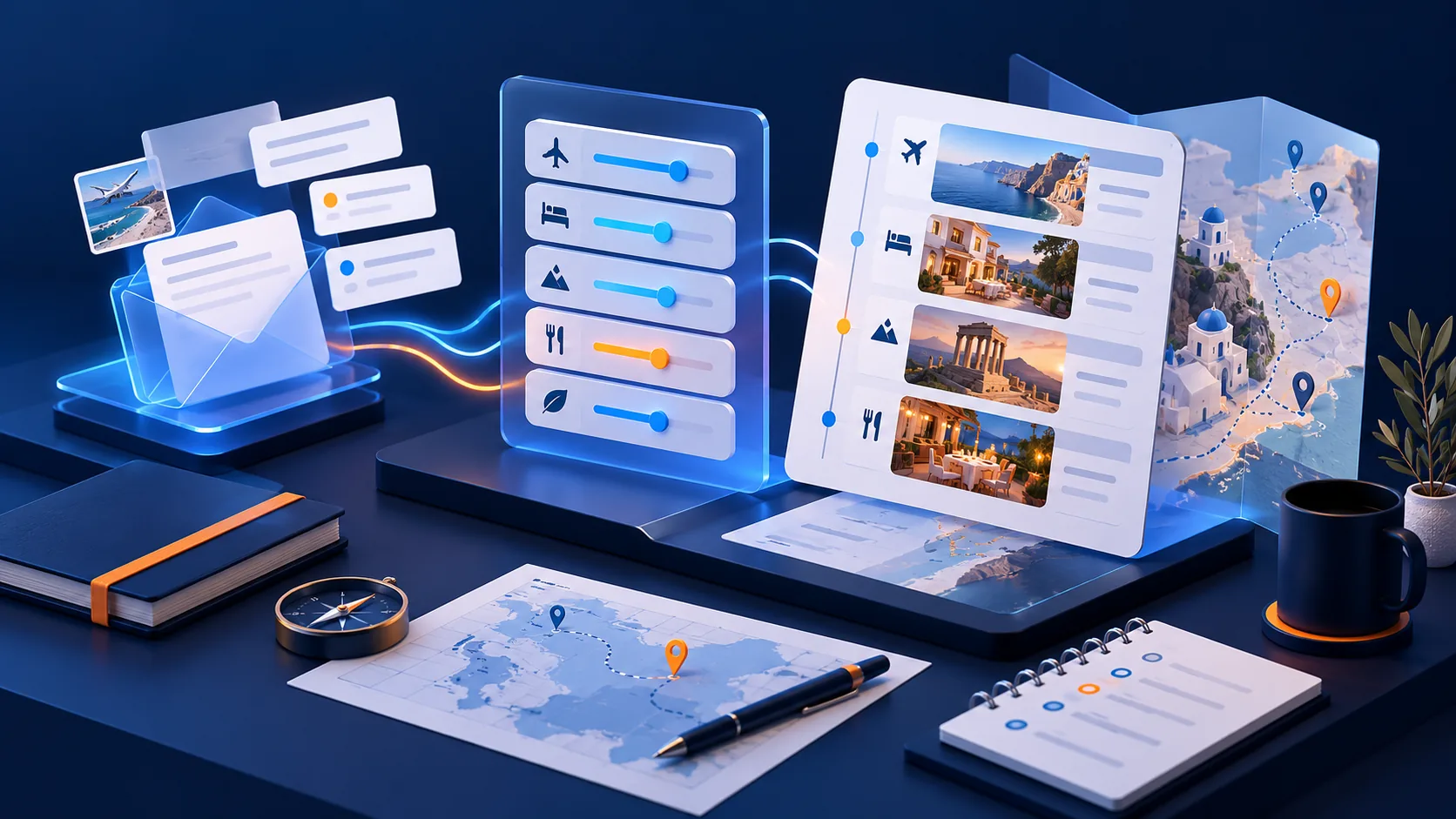
The engagement delivered an AI-assisted booking workflow rather than an autonomous planner. Incoming enquiries are structured against a defined model of what a complete request contains, with gaps flagged rather than inferred.
From there the workflow supports itinerary preparation — assembling a starting structure and the relevant context — and carries the customer record through into CRM and the agent workflow, so the information stops living in an inbox.
Complex cases continued to route to human agents by design. The difference is that they arrive with the relevant information already assembled, so the consultant’s time goes into judgement rather than reconstruction.
- Structured enquiry captureFree-form requests mapped onto a defined model, with missing information identified at capture.
- Itinerary preparation supportA prepared starting point for a consultant to edit rather than a blank document.
- Context into CRMCustomer context carried into the CRM and agent workflow rather than left in a mailbox.
- Human routing preservedComplex cases routed to agents deliberately, with the information already assembled.

Operational effect
What changes when this work lands.
Ranges below describe what engagements of this shape typically move. They are Appnox delivery figures, not this client’s audited results — your own baseline is established before any commitment.

30–45%
less time per enquiry before a consultant can quote
Typical range35–50%
faster first-draft itinerary preparation
Typical range40–50%
fewer manual re-entries between systems
Typical range25–35%
shorter first-response window on inbound enquiries
Typical rangeIndicative ranges observed across comparable Appnox engagements. Not audited client results. Outcomes vary with scope, data quality and starting point.
How it was delivered
Narrow first, measured, then widened.
The engagement followed the same sequence we apply to workflow automation generally.
01
Define what complete means
Agree, with the operational team, what a qualified enquiry contains. This was a commercial conversation as much as a technical one, and it set the contract everything downstream was built against.
02
Baseline the existing path
Establish what qualification cost before anything changed, so the result could be compared against something real rather than against an impression.
03
Build one path end to end
Take a single enquiry route all the way through to a consultant-ready record, rather than building a shallow layer across every channel.
04
Run against real traffic
Operate alongside the existing process using genuine enquiries, which is where the definition of complete was corrected.
05
Widen and hand over
Extend coverage with the baseline in hand, and document the workflow for the team who operate it.
Before we talk
Questions this usually raises.
The pattern — structure the enquiry, assist the preparation, carry context into the systems of record, keep judgement with the consultant — generalises well across travel businesses. What does not generalise is the integration surface, which depends entirely on what your systems expose. That is what the free call establishes.
Reference conversations are arranged case by case and with the client’s agreement, usually at a later stage of a procurement process rather than at first contact. We will not commit a client’s time before there is a real evaluation underway.
The first end-to-end path was a matter of weeks rather than quarters, because the scope was deliberately narrow. Widening took longer and was paced by the client’s operational availability more than by engineering.
Keep exploring
Related work
Start with a conversation
Bring us the workflow, not the technology.
If something here describes your operation, thirty minutes with a solutions architect is usually enough to establish what is worth doing about it.
Free · 30 minutes with a solutions architect · No obligation to commission an audit · sales@appnox.ai